
B2B lead generation that actually works for lean companies
We hear it all the time from companies we work with: “We’ve grown our business through referrals, but we need help building a bigger B2B lead generation strategy.”
This is a typical scenario for lean or owner-led B2B companies. They grow a stable, profitable business through their existing network. Then when it’s time to grow beyond who they know, the team is left questioning, “How will we find new leads?”
They might throw out some email marketing campaigns, try posting a bit on LinkedIn to reach potential customers, or bite the bullet and pay for that ZoomInfo account to get phone numbers and try some cold calling…only to come up with an empty pipeline.
There’s a better way.
B2B lead generation is a big topic with a lot of potential paths to take. We’re going to cover the one strategy we’ve seen work time and time again to uncover new business for our clients in industrial and manufacturing sectors.
First, let’s look at what lead generation really means and how it plays into a full sales pipeline.
What is lead generation?
Lead generation means getting your company’s message in front of potential buyers (aka leads) in a way that makes them interested in working with you. It’s the methods and activity involved in gaining new leads.
Simple enough, right? Let’s build out our understanding with a few more key B2B sales terms.
B2B pipeline stages
Discussing B2B lead gen often leads teams to a bigger conversation around the difference between a “lead” and an “opportunity.” Maybe you’ve also heard the terms Marketing Qualified Lead (MQL) and Sales Qualified Lead (SQL).
There aren’t any official definitions for these terms, so we’ll share the working definitions we use when we integrating Account-Based Marketing programs with clients. Teams will typically modify these sales funnel categories to fit their context and add more specific lead scoring parameters, so this is just as a baseline:
Lead: Anyone whose email address we have access to (gained through LinkedIn, conferences, ZoomInfo, etc.).
Marketing Qualified Lead (MQL): A contact the marketing team has looked at and deemed viable for a sales opportunity, or, a contact who is messaging us (through website, email, etc.) to ask for more information.
Sales Qualified Lead (SQL): A contact the sales team has reached out to and believes there is potential for new business with.
Opportunity: A contact that has expressed interest in receiving a quote or learning more about our services.
Customer: A contact whose opportunity turned into a signed contract.
The first step: Make marketing personal
Okay, so how do we take someone from a potential lead to a paying customer?
Our years of experience have taught us that the best B2B lead generation strategies start with a deep understanding of your customers and a targeted list of who will make the best future customers.
Often when making an initial lead gen plan, the first instinct is to jump to tactics (or what we refer to as marketing programs). Things like: social media, email marketing, white papers, cold calling, gated content on landing pages, referrals, case studies, events, or public relations.
But pause and think: Who are these lead generation campaigns designed to reach? If the answer is, “Buyers who work for companies that fit our ICP (Ideal Customer Profile),” that isn’t descriptive enough in the B2B marketing world.
Even though B2B sounds broad, you need to make it personal.
If you’re doing a team brainstorm about a better lead generation process, instead of talking about “leads” and “prospects,” give them actual names. Not personas with made-up names like “SaaS Buyer Sally” and a stock image — go actually look at companies you’d like to work with. Look at employees of that company on LinkedIn and write down their names.
Instead of designing lead generation efforts for a fictional person, you’ll think about marketing strategies that will actually connect with that person. This approach is in line with account based marketing (ABM), which is a method that focuses your marketing team’s efforts on the exact companies and decision-makers who can make the biggest impact on your growth. ABM generates high-quality leads with better conversion rates instead of getting you any old type of lead from anywhere.
B2B lead generation exercise to do today
Think about a few companies you’d like to close the sales cycle with this year.
Identify a decision-maker role within this company. If it’s a startup, it might be the CEO. If it’s a big organization, the B2B buyer might be a director-level role.
Then answer the following questions:
What are the top problems your decision maker is trying to solve right now? Start with the broader operational and business problems of your potential lead. Maybe it’s automation, brand awareness, sales, or growth. Identify which of those your company is best-suited to solve.
How do these problems affect their day-to-day? Not the company’s daily operations, but that person’s work day. What are their pain points?
Where are they looking for help and support to solve these problems? Think of where the potential new lead would look for help outside their company. It might be industry publications, online forums, local events, a Google search, past coworkers, peers, or sister plants, for example.
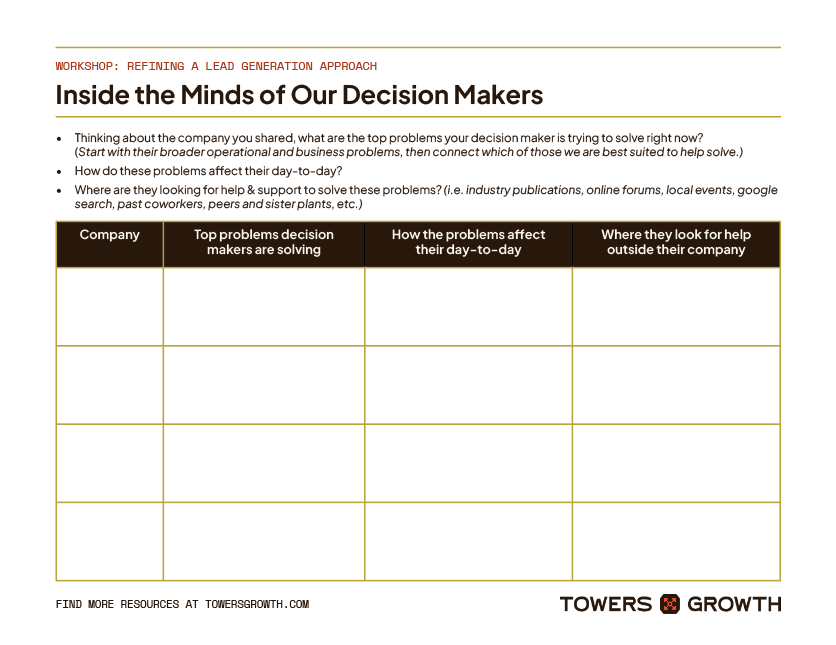
Then, from what you wrote in the “Where are they looking for help” column, think about where you could intersect with them in their day-to-day, in a way that isn’t a cold email or something that screams “sales rep”:
If they’re looking for help in online forum groups, get active in relevant subreddits and groups.
If they tend to read industry publications to find ideas and inspiration, do some outreach to the editors of those publications and see how you can contribute to their content.
If they prefer to do online research, start focusing on search engine optimization (SEO) and content marketing. Publish informational, helpful content geared at your target market.
If they go to local events, apply to host a workshop or webinar at a conference this year.
Get started on B2B lead gen
B2B lead nurturing is not about paying for the latest, greatest, AI-powered lead generation tools. It’s simply about understanding who you sell to and where they spend time.
Understand your customers first. Then think of how you can speak to them.
If you’re feeling stuck or overwhelmed, this is what we do every day. We specialize in B2B lead generation that helps our clients build a strategic, connected marketing system to reach their target audience. Contact Towers Growth and let’s talk shop about what’s missing in your lead generation strategy and how we can fix it.