The beginner’s guide to Account-Based Marketing for industrial companies
How modern industrial companies are using ABM to win dream customers and shorten the path to revenue.
Most industrial companies have built their growth on reputation, relationships, and being in the right place at the right time. RFQs roll in, long-term clients send referrals, and trade shows create just enough activity to feel productive.
But the landscape has shifted. Buyers do more research on their own, sales cycles take longer, and the most valuable accounts rarely come knocking on your door. Traditional lead generation simply can’t keep up in a world where attention is fragmented and teams are stretched thin.
Account-Based Marketing offers a way out of the scramble. Instead of waiting for leads to appear, ABM helps you intentionally target the accounts that matter most. It brings precision to your marketing efforts and structure to your outreach, so your team isn’t guessing where to focus. With ABM, you stop chasing volume and start building momentum with the companies that fit your expertise best.
This guide is built for leaders inside industrial companies who operate in complex environments — those who sell highly technical services, operate in niche markets, and consistently navigate long buying cycles.
If you’re ready for a strategic, relationship-driven approach to growth, ABM is built for you.
What Is Account-Based Marketing? And why it works for industrial companies.
At its core, Account-Based Marketing is a focused growth strategy where sales and marketing join forces to create tailored buying experiences for a well-defined set of high-fit accounts. It’s not just a tactic, it’s a lens.
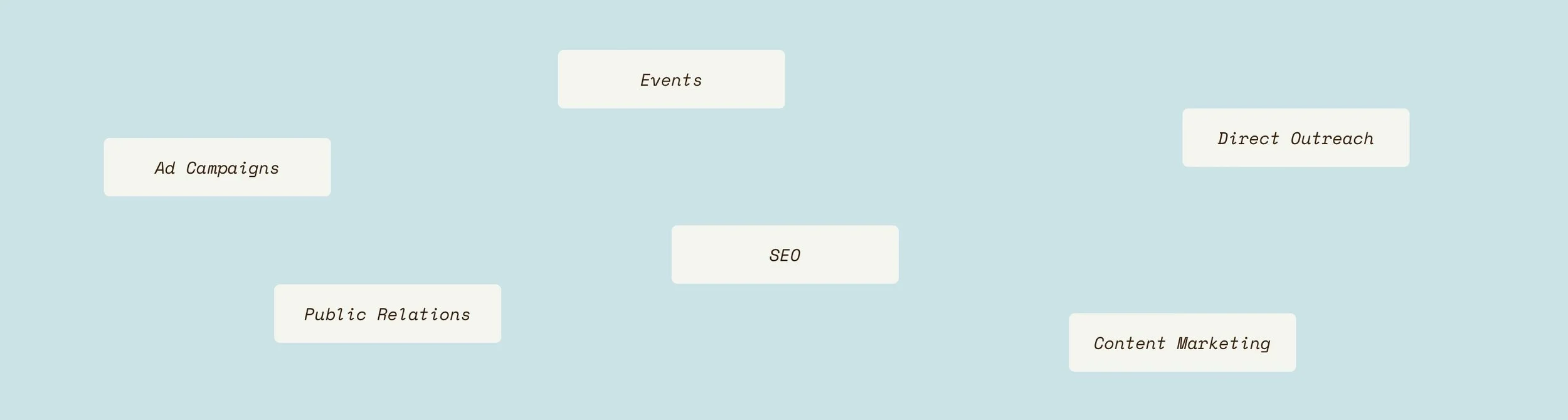
We like to describe ABM as the wrapper around all your marketing efforts. It shapes how you think about events, content, outreach, and even internal alignment. Instead of dabbling in random marketing efforts, you start making decisions based on whether the effort will help you reach the accounts that you already know are right for your business.

ABM turns reactive tactics into intentional systems.
This shift stands in stark contrast to traditional marketing models. Traditional lead gen rewards volume: cast a wide net, gather as many names as possible, and sort out the qualified ones later. ABM flips that completely. You identify the best-fit accounts first, then craft outreach and content specifically for them. The difference feels dramatic.
Traditional marketing often looks like a kindergarten soccer team — everyone running with enthusiasm but no sense of direction. ABM feels like a seasoned varsity team, aligned around the same goal and coordinating every movement to score.
Should we attend this event? Only if our ideal accounts will be there.
Should we write this blog post? Only if it answers questions our ideal buyers ask.
Should we invest in a new tool? Only if it supports reaching high-fit accounts.
That’s why ABM fits industrial markets so naturally. These are environments defined by long sales cycles, large deal sizes, and complex internal decision-making. No single buyer drives the process.
ABM mirrors this complexity. It helps you reach each stakeholder with the right message at the right time, building trust and momentum in a way traditional marketing never could.
ABM in action: A mini case study
We recently helped a precision manufacturer adopt ABM to expand their presence into the aerospace and defense markets. We started by defining their ICP and narrowing their target list from over 200 companies to 16 high-value accounts.
With that clarity, we were able to launch a series of LinkedIn campaigns designed specifically for engineering and procurement roles inside those accounts. Within a few months, they saw steady engagement from 11 of the companies on their list. We gained leads from six of those accounts, and one converted into a major new opportunity.
Even more powerful, the team could see exactly which messages resonated most with their buyers, allowing them to customize outreach to what mattered to each contact. The program didn’t require a massive budget or complicated tech. It required focus.
The core pillars of ABM
A strong ABM program rests on a few foundational elements. When these are in place, everything else becomes clearer, faster, and far easier to execute.
Ideal Client Profile (ICP)
Your ICP is your north star. It defines the companies where you win most consistently and the conditions that make those partnerships so successful. Instead of guessing who might be a good fit, your ICP clarifies the attributes you value, like their industry, facility size, equipment used, certifications required, geographic footprint, typical deal size, and even organizational culture.
When your ICP is sharp, marketing naturally becomes more focused and sales outreach becomes far more efficient. You stop wasting time on accounts that would never convert and start investing heavily in the ones that are the right match.
Target account selection
Once you know what “ideal” looks like, you can create a list of accounts that match the profile.
This is where ABM really starts to take shape. Instead of hundreds or thousands of potential leads, you narrow your focus to a manageable list of the companies that are most likely to produce long-term value.
This list can be comprised of:
Fellow member companies at industry associations
Your existing sales pipeline
Research in databases like ZoomInfo, LinkedIn, and D&B
Companies within your own network
A strong list gives you a focused base to build from and instantly brings more clarity to your marketing.
Sales & marketing alignment
ABM only works when sales and marketing operate as one team. This alignment goes beyond a weekly meeting. It means agreeing on who your ideal accounts are, how to approach them, what success looks like, and how you’ll measure progress.
Marketing creates awareness and opens doors; sales deepens the relationship and carries conversations across the finish line. The more tightly these two functions collaborate, the more seamless the buying experience feels for your prospects and the faster your team can move.
Personalized outreach & content
With your targets clear, you can finally create content and outreach that speaks directly to the realities of your buyers. Engineers care about precision and throughput. Procurement cares about risk reduction. Operations cares about uptime and process efficiency.
ABM allows you to talk to each of them differently. The most effective programs use a tiered approach, such as:
One-to-one outreach for the highest-value accounts
One-to-few campaigns for accounts in similar segments
One-to-many content that builds general awareness
The more relevant your messages are, the faster you build credibility.
If you’re starting from scratch on content, begin with case studies. These are going to be the highest-impact content pieces you can build that quickly and clearly communicate the value of your solution. Identify a few client stories that can speak to ideal accounts and write 1- to 2-page case studies for your website.
Measurement & optimization
No ABM program is complete without measurement. But the metrics look different from traditional marketing. Instead of tracking generic lead counts, you pay attention to whether the accounts you care about are actually engaging via visiting your website, viewing your LinkedIn posts, opening your emails, or requesting information.
Over time, you measure how many of those engaged accounts turn into meetings, opportunities, and wins. And because you’re tracking account-level activity, it’s much easier to refine your approach based on what actually works.
Every aspect of your marketing program should be measurable towards progress at your ideal accounts. The best way to visualize this is within the opportunity dashboard of your CRM.
How to launch your first ABM program
Here’s a practical roadmap you can follow to start up your first ABM program without overcomplicating the process.
Phase 1: Strategy & list building
Your first step is defining who you want to reach and why. Clarify your ICP and review your closed-won history to spot patterns in the customers where you’ve had the most success.
Once the picture becomes clear, you can begin building your first target account list. This list should focus on companies that fit your profile and show signs of operational or industry momentum. We recommend starting with 10 to 30 accounts per sales rep.
Phase 2: Research & messaging
When your list is set, it’s time to learn about the people inside those companies. Every industrial buyer group looks different, but most include engineers, procurement managers, operations leaders, and at least one financial decision-maker.
Your job is to understand what each of these roles cares about and what pain points they experience most often. Start by looking at contacts’ LinkedIn profiles and see what they’re posting about, commenting on, and resharing. You can also look at what professional groups they belong to on LinkedIn and see what conversations are happening in those groups. We also find it helpful to subscribe to a few industry publications these contacts follow to gain more insights on what they’re reading on a weekly basis.
From there, you can craft message themes that speak directly to their reality, whether that’s reducing downtime, improving tolerance capability, expanding throughput, or mitigating supply chain risk.
The more specific your language, the more credible your company becomes.
Phase 3: Content & campaign planning
ABM thrives on content that feels tailored, not generic. This doesn’t mean creating hundreds of assets. It means building a small, strategic library of materials that demonstrate your expertise.
A strong case study can carry an entire campaign. A short technical explainer can unlock an engineering audience.
At this stage, you decide which channels will carry this content to your accounts. Most industrial teams start with LinkedIn and email because they’re accessible and easy to track. Others pair digital outreach with phone calls or even physical mailers to make a stronger impression.
Phase 4: Outreach & engagement
Once your content and messaging are set, you’re ready to engage your accounts. This is where your marketing and sales teams coordinate their actions.
We love starting with a LinkedIn ad campaign to introduce a relevant problem directly to your target buyers, leading them to a landing page that expands on the idea.
From there, your sales team follows up while the account is warm. You stay present in the industry, showing up at events where your buyers are, publishing your perspective in relevant publications, and being the knowledgeable voice they come to trust. The key here is consistency, not complexity.
MARKETING IN ACTION
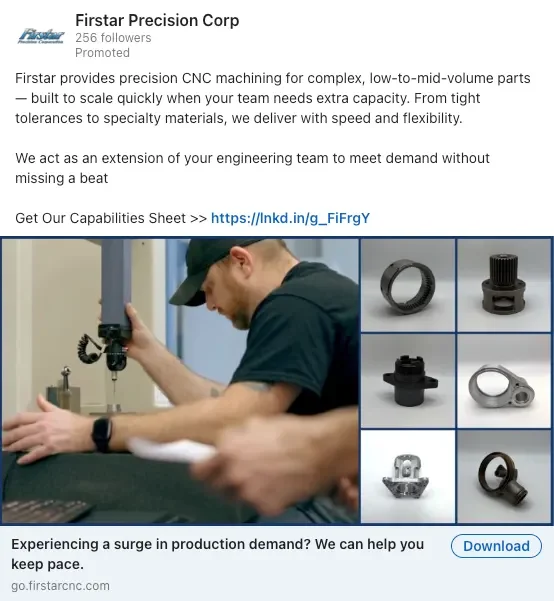
This LinkedIn ad was placed in front of buyers within Firstar’s target accounts and took them to a landing page describing Firstar’s capabilities. This allowed buyers to understand how Firstar could fill their needs and gave them options to explore the company.
Within a $500 ad budget, we saw 40 clicks to the landing page and were able to see which companies interacted with the ad. This helped us prioritize one-to-one outreach and move several target accounts into the opportunity pipeline.
Phase 5: Measure & learn
After your program is active, measurement becomes your guide:
Which accounts are engaging?
Which messages are winning attention?
Which channels perform best?
Refine your approach overtime. Update your target account list as you learn, adjust your messaging as patterns emerge, and double down on the activities that create real movement.
Celebrate early wins to keep your team aligned, motivated, and confident in the process.
Ready to put ABM to work for your sales team?
Schedule a discovery call and we’ll walk you through what your first 90 days could look like.
Read More